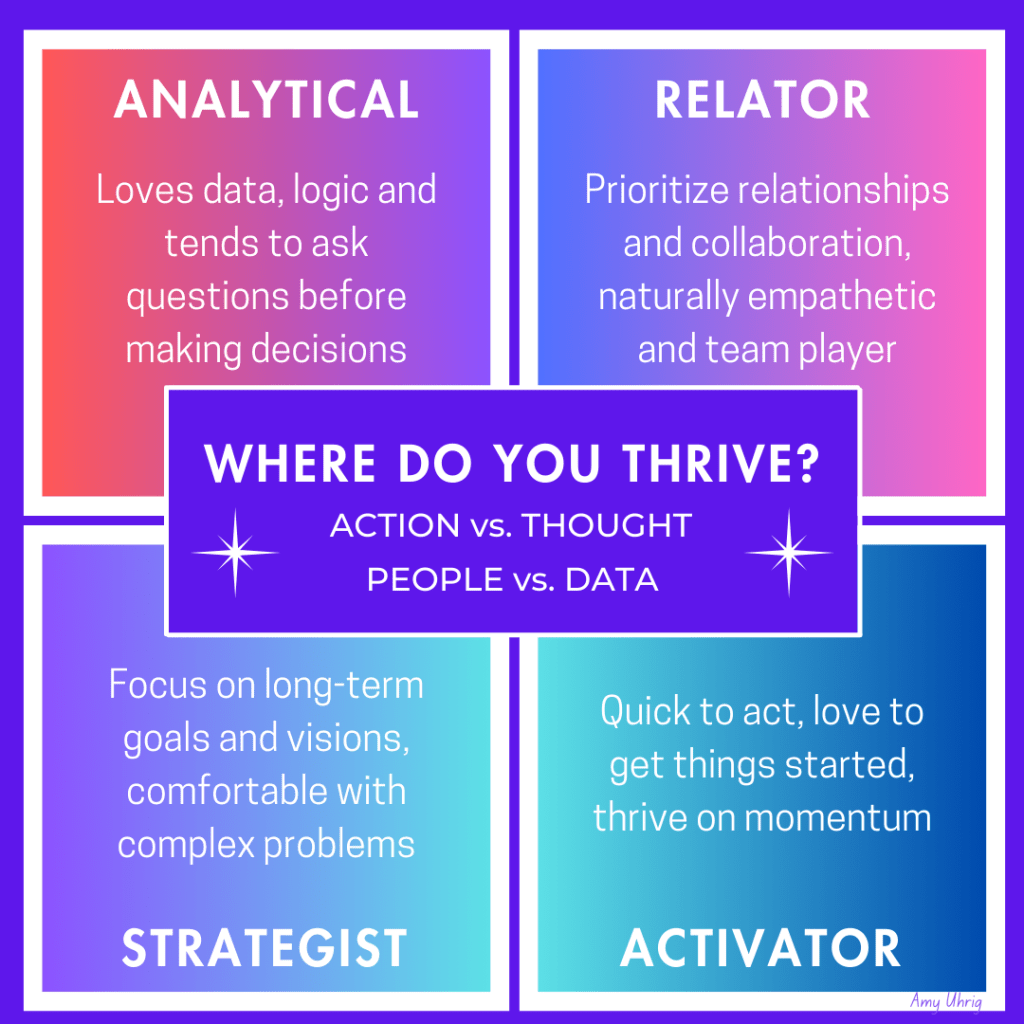
Where do you see yourself in this quadrant?
I’ve often been recognized as an Activator and personally identify as a Relator. But here’s the truth: it takes all of us—with our unique passions and skills—to make business (and life) thrive!
Do you find yourself leaning more toward action or reflection? Are you naturally drawn to people or data?
Each of us operates in multiple spaces, but one or two quadrants probably fuel your energy and inspiration the most!
What strategies do you use to strengthen the areas that aren’t as natural for you?
When I first stepped into management, I was confident I could find answers to the challenges ahead. But the real struggle wasn’t with the responsibilities—it was with myself.
As my role grew, I wasn’t confident I could truly be me. I felt like I had to fit into a certain mold, and that made the voice of imposter syndrome louder.
It took time, but by the time I reached the director level, I realized something powerful: the key to leading well wasn’t about fitting into someone else’s idea of what leadership should look like. It was about showing up as myself, unapologetically.
If you’re hearing that same inner voice telling you that you’re not enough, or that you have to be someone else to succeed, I challenge you to take a step back.
Ask yourself this: In which areas of your life do you feel like you’re wearing a mask? Where are you conforming to what you think you should be rather than embracing who you are?
Take one step to silence that imposter voice. Maybe it’s speaking up with your own perspective in meetings or leaning into your personal leadership style, rather than mimicking someone else’s.


With technology advancing at a faster pace than ever, the rate of change in organizations has become a constant challenge. Yet, even in this fast-moving environment, it’s critical to give people the opportunity to absorb, practice, adopt, and eventually master new tools or processes.
If the rate of change outpaces people’s ability to adapt, we risk asking them to run before they’ve had a chance to crawl. This isn’t just about meeting deadlines or exceeding expectations—it’s about respecting the journey of those affected by the change.
Think of it like a Couch to 5k program. Just as we wouldn’t expect someone to run a race without the proper training, we shouldn’t expect teams to perform optimally without the time to learn and adjust. It’s essential to meet people where they are, regardless of the pace of external pressures. Lasting change happens when everyone is set up for success.
Let’s not forget the human side of transformation. Change should be a marathon, not a sprint.
How have you navigated change in your organization? Whether you’ve been responsible for rolling it out or been impacted by it, I’d love to hear your experiences in balancing speed with the time needed to fully adapt.
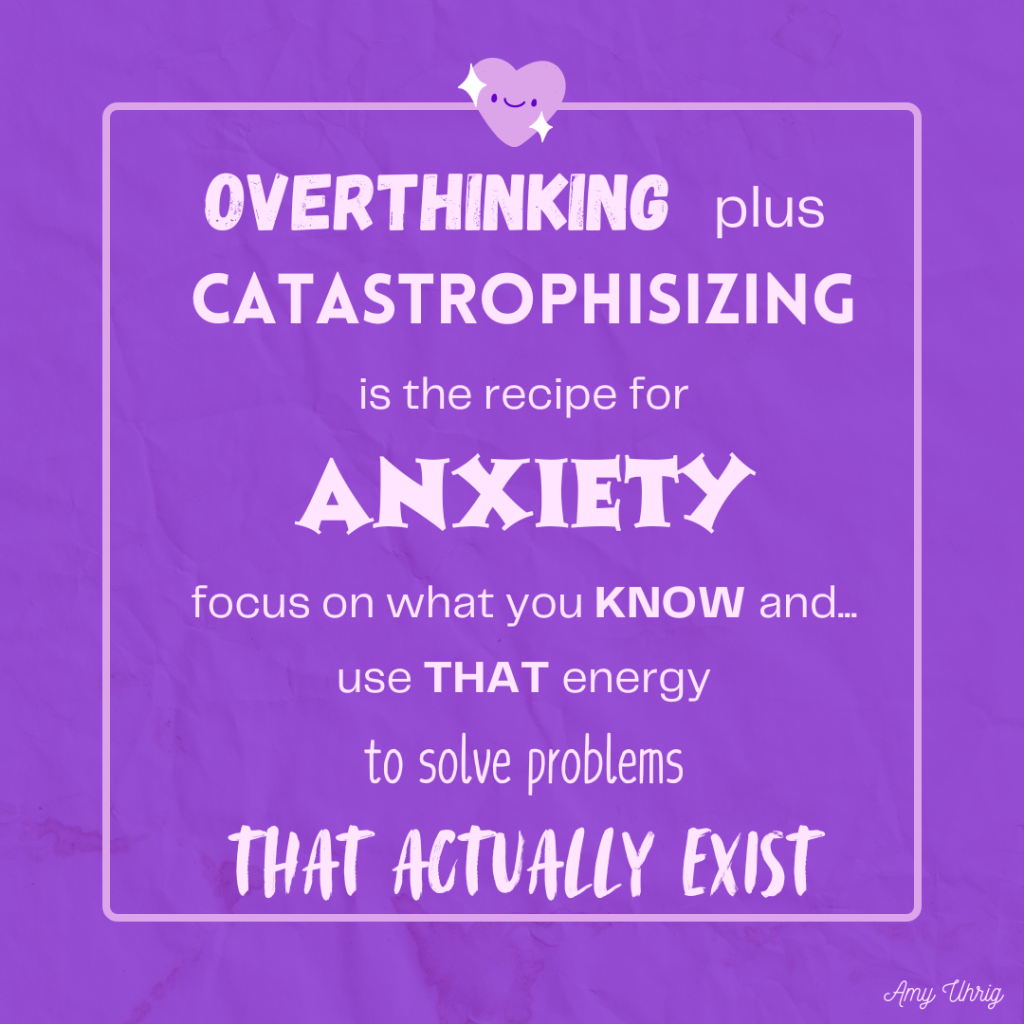
It’s easy to get caught in the cycle of overanalyzing every possible outcome and imagining the worst-case scenarios. But when we do this, we’re feeding our anxiety more than we’re solving real problems.
Here’s the truth: overthinking doesn’t lead to better decisions—it leads to paralysis.
Instead, let’s focus on what we KNOW and take actionable steps to solve the problems that actually exist.
By focusing our energy on what’s real and within our control, we can stop anxiety in its tracks and move forward with confidence.
What’s one thing you can shift your focus to today that’s within your control?
 Amy Uhrig